
BLOG

- Home
- Blog
- Floor Mat/Door Mat
- Sourcing Commercial Entrance Mats? How Singform Developed the Materials, Manufacturing, and Quality Control Buyers Need
Sourcing Commercial Entrance Mats? How Singform Developed the Materials, Manufacturing, and Quality Control Buyers Need
November 09,2026
Doormats help prevent workplace injuries; it pays to find a reliable supplier.
Every year, slips, trips and falls are the leading cause of non-fatal workplace accidents in the US, according to the Occupational Safety Administration, but as many as 95% of these cases are preventable.
In many incidents , the humble doormat could have saved workers from serious injuries, and businesses from higher insurance premiums. With more than $10 billion a year on the line for US businesses from slips trips and falls – on the same floor level alone – it pays to find the right mats from a quality supplier.
But what does the right floor mat look like? It depends.
What should buyers look for in door mats?
To figure out the right commercial door mat for your business, ask yourself a few questions:
How big is the entrance you're covering? For small to medium entrances, a large mat will very likely serve your needs. For larger areas it makes more sense to have zones covered with multiple smaller mats.
How many people are going to be using the area? Mats that see a lot of foot traffic will move around if they don't have proper backing, while the right material can help extend the shelf life of a mat. For example, in high-traffic areas, using coarser yarn can provide better durability and more effective dirt-scraping performance than using only fine yarn.
Will that mat be used indoors, outdoors, or be exposed to weather? Placing your mat at a building entrance means your mats will get wet sometimes from rainy or bad weather. Similarly,mats near sports facilities like pools will be damp 24/7. Mats for dry areas need to absorb water, while drainage mats need to lose it.
What's your budget? There are pros and cons to every detail. If you focus on bespoke design and perfect color matching, that costs more. If you always go for the cheapest option, you could miss out on the best backing materials.
A commercial mat supplier can help you figure out how to customize a mat design for your needs.
What can be customized for commercial projects?
For commercial projects, nearly everything about a mat can be customized. The mat logo or design is one of the most noticeable features. Depending on how many colors are used, and how standard they are, the cost and minimum order quantity might be higher or lower. The thickness of a mat makes a big difference.
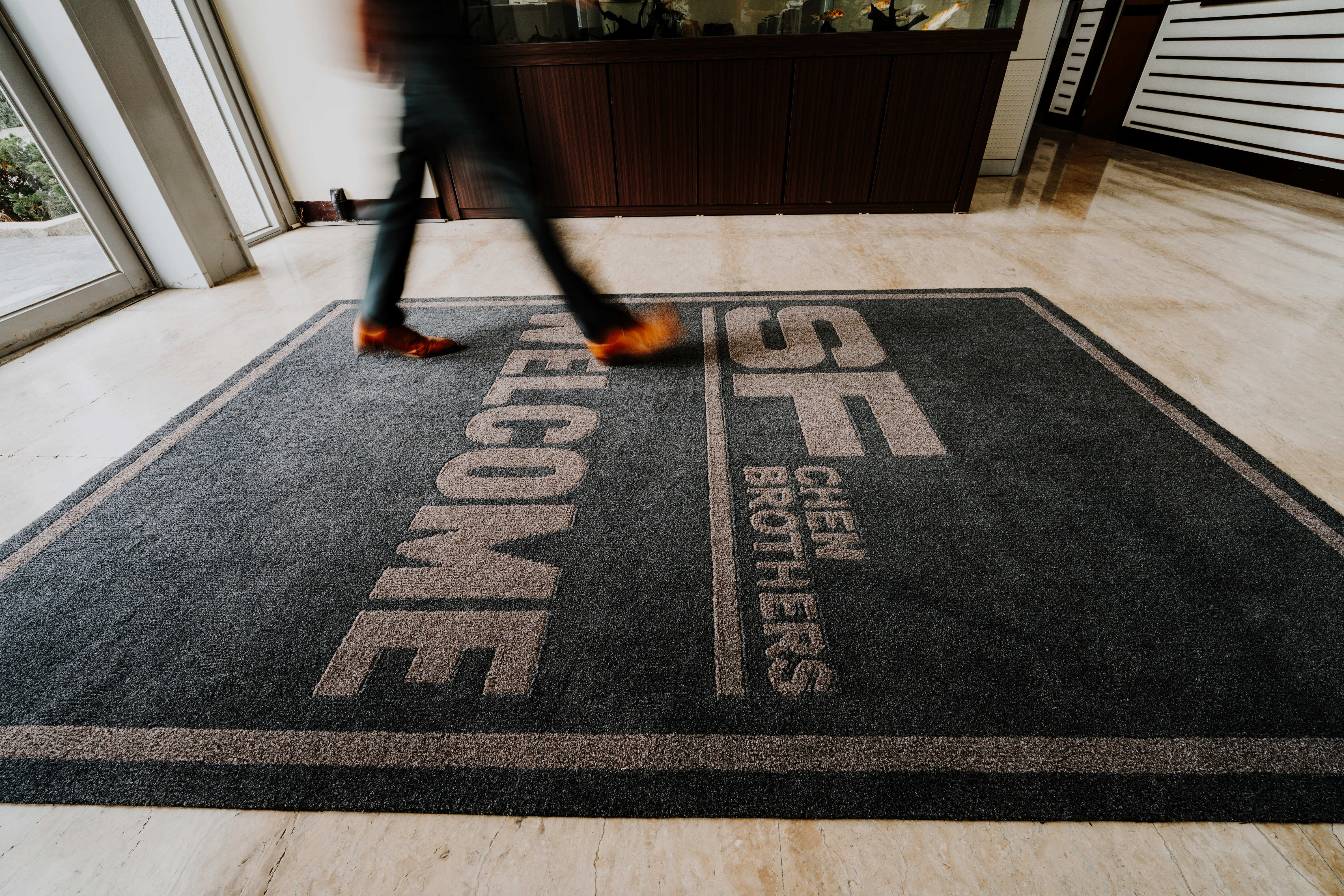
Custom logo entrance mat in use. Image by Singform Enterprise Co., Ltd.
A thick mat lasts for longer, but costs more; a thinner mat is more affordable, but wears out more quickly. Material choice will impact the style and feel of the mat, as well as its lifespan.
Tufted mats are more expensive but feel more luxurious and last longer. Needle-punched PET is more affordable, but doesn't last as long and feels more basic.

Close-up of a tufted commercial mat surface. Image by Singform Enterprise Co., Ltd.
Even though it’s out of sight, your choice of backing material is also important and customizable.
Different backing materials vary in properties like weight, slip resistance, and cost. Two of the most common, rubber and vinyl, have their own advantages and disadvantages. The most suitable material should be selected based on a combination of factors, including the application environment, usage habits, and overall cost. Rubber, for example, tends to be heavier and suited for cold or damp weather, while vinyl is lighter and may be suited for dry places.
Working with a company that manufactures mats can make some of these choices easier than if you work with a mat wholesaler because of their experience with different clients.
Why manufacturing history matters
There are two main types of supplier for commercial entrance mats. An intermediary that buys mats from a manufacturer, rebrands them and sells them on, or you can a manufacturer that sells direct to customer.
It's worth dealing directly with manufacturers when possible:
- They know the materials used to make every mat, so they can answer which mats are best for your use case. An intermediary might not know the difference between a rain mat and a drainage mat.
- Manufacturers can customize designs to suit your needs. An intermediary doesn't have control over production and might not own the design, so they have limited ability to modify products as needed.
- A manufacturer can set up a production run themselves and can scale it up or down to meet a given order size. An intermediary trades mats from other companies, so if their suppliers don’t deliver, they might not be able to fulfil your order.
- Because an intermediary is a proxy for other companies, it's hard for them to guarantee that every mat they sell meets the same quality standards. A manufacturer controls the whole process, so they can meet strict certification requirements.
How Singform developed its doormat capabilities
Johnson and Jessie Chen were already successful entrepreneurs when they received a strange offer.
In 1987, they'd launched a small car accessories company called Singform. At first, they'd just bought mats from other manufacturers, rebranded them, and sold them on. That was alright as far as it went.
But they weren't getting the real business: making mats directly for car makers. Car makers didn't want to deal with suppliers who couldn't guarantee long-term supplies of mats. And Johnson and Jessie didn't make mats: they just resold them.
So in 1993, they set up their own production line. By 1995, they'd signed deals to make car mats with Nissan, Mazda, Ford, and Mitsubishi.
An offer came for a chance at the same playbook. A global brand wanted to partner with Singform for distribution. They would make the doormats. Singform would distribute them.
Instead, the brothers sent an offer back: let us make the mats. After the deal was signed, Johnson and Jessie got to work.
Over the next few years, Singform would vertically integrate the whole doormat operation, just like they had for car mats. First was figuring out how to translate car mats into door mats. Then, drainage mats for wet areas like pools. Next, figuring out how to make their own carpets and investing in tufting equipment to make different textures. And finally, taking the rest of the stack: back, lamination, cutting, and finishing.
Singform now handles the whole process of floor mat development, from the design of the product to mass production. They continuously improve their processes and develop their own products. And they distribute worldwide.
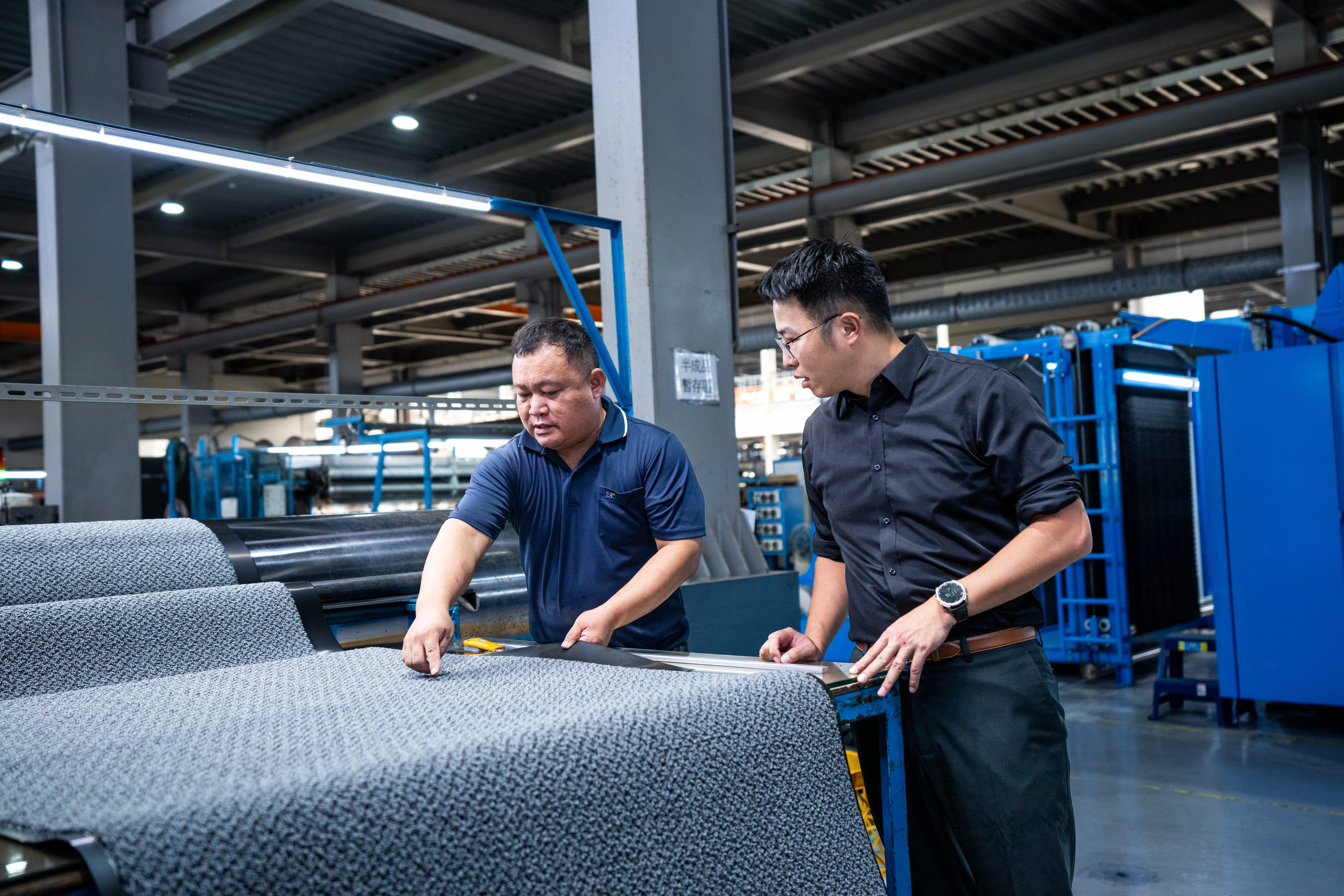
Singform staff inspect mat material on the production line. Image by Singform Enterprise Co., Ltd.
Which commercial doormat projects has Singform worked on?
Singform has worked with many international clients, including a large UK retailer to supply doormats for stores nationwide. To succeed, they needed to draw on all the capabilities they'd learned over the years:
Mats needed to be made to bespoke size and color requirements. They needed to use materials to fit the retailer's requirements. Prices needed to match the buyer's expectations. And supply-chain delays were unacceptable.
Singform developed a new mat design for the retailer, and sent it to the production line. Over 18 months they delivered 12 shipping containers.
How to find a reliable supplier for door mats
There's a few things worth checking:
- Whether you're dealing with a manufacturer or an intermediary. Manufacturers can be a lot more flexible than intermediaries because they own the whole production stack.
- Minimum order quantity (MOQ) requirements. For simple and standardised designs, MOQs will be lower than for complex, bespoke, or color-matched mats.
- Which materials the supplier's able to work with. Different materials need different equipment and training. For example, tufting guns are needed to make piled mats.
- Whether the supplier can collaborate on product design. Some manufacturers prefer to work build-to-print, which means the customer is fully responsible for design. Other manufacturers, like Singform, are able to collaborate on product design so that the doormat's tailored to your company’s specific needs.
- Ask about certification and auditing. A good manufacturer will hold ISO9001 (quality control systems), ISO14001 (environmental management systems), and other quality and ESG related certifications.
Conclusion
Floor and door mats keep customers and workers safe, and can help prevent injuries from slips, trips, and falls. A good supplier will work with you to make sure their mats match your branding, make sense for the area you're placing them in, and stay within your budget. They can make sure the mats arrive in time to avert catastrophes. With proper doormats in place, we can protect the safety of our customers, colleagues and workers, and make the workspace look stylish too!
Article Classification
Recent Articles
- Sourcing Commercial Entrance Mats? How Singform Developed the Materials, Manufacturing, and Quality Control Buyers Need
- Our latest upgrade: printing solutions that work across multiple materials
- Why are doormats and floor mats important? How to choose a doormat? (Part 2)
- What is a tufted carpet and how to choose a doormat? (I)
- How to prevent sliding of doormats/floor mats